
DHI Eyebrow Transplant: The Comprehensive Guide to Procedure, Costs, and Permanent Results. In the modern era of aesthetic medicine, the focus has shifted from “noticeable changes” to “natural enhancements.” Among these, the DHI Eyebrow Transplant (Direct Hair Implantation) stands out as the most sophisticated method for restoring eyebrow density. Whether the loss is due to alopecia, over-grooming, or trauma, DHI offers a permanent solution that mimics the intricate nuances of natural hair growth.
DHI Eyebrow Transplant: Redefining Facial Aesthetics with Precision
Unlike scalp hair, eyebrows have a unique anatomy. They require a specific exit angle, a particular density, and a sharp eye for facial symmetry. This is why the DHI technique, utilizing the specialized Choi Implanter Pen, has become the preferred choice for elite clinics worldwide.
The Science Behind DHI: How It Works
To understand why a DHI Eyebrow Transplant is superior, one must look at the mechanics of the procedure. Traditionally, hair transplantation involved two separate steps: opening channels (incisions) in the skin and then placing the grafts into those channels.
DHI simplifies and optimizes this. By using the Choi Implanter Pen, the surgeon can load a hair follicle into a hollow needle and “inject” it directly into the skin. This eliminates the need for pre-cut channels.
The Role of the Choi Implanter Pen
The tip of the Choi pen is incredibly fine, ranging from $0.6mm$ to $0.8mm$ in diameter. This allows for:
- Minimal Tissue Damage: Since no incisions are made, the skin trauma is negligible.
- Zero Scarring: The micro-punctures heal within hours, leaving no visible trace.
- Precise Angulation: The surgeon can rotate the pen to match the exact 15-degree angle required for the “tail” of the eyebrow.
DHI vs. FUE: Which Method is Better for Eyebrows?
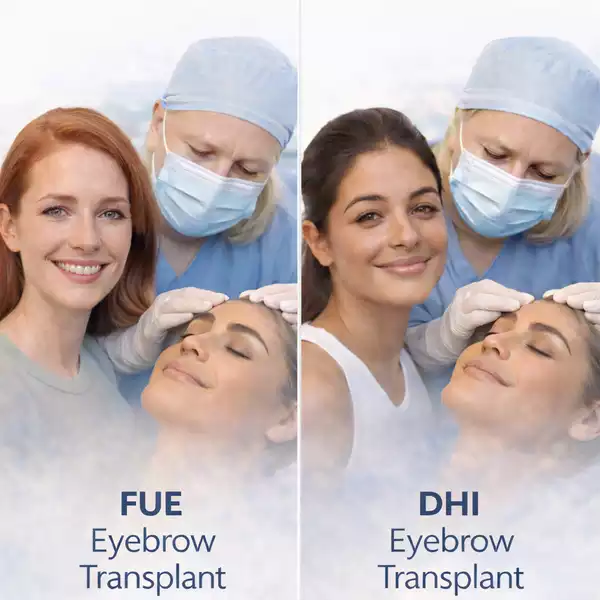
While both methods are effective, the DHI Eyebrow Transplant offers specific advantages for the facial area that standard FUE (Follicular Unit Extraction) cannot match.
| Feature | FUE Eyebrow Transplant | DHI Eyebrow Transplant |
| Channel Opening | Required before implantation | Not required (Direct) |
| Graft Survival | High, but follicles spend time outside | Maximum, due to rapid placement |
| Bleeding | Moderate | Minimal to none |
| Density | Good | Excellent (higher density per $cm^2$) |
| Recovery Time | 7-10 days | 3-5 days |
| Natural Look | High (depends on skill) | Highest (technologically assisted) |
The primary reason DHI wins in the eyebrow category is the depth control. If a follicle is placed too deep, it can cause “pitting” or cysts. If it is too shallow, it won’t grow. The DHI pen allows for millimetric depth control that is difficult to achieve manually in a pre-opened channel.
Who is an Ideal Candidate for a DHI Eyebrow Transplant?
Not everyone is a perfect candidate for this procedure. A thorough evaluation is necessary.
1. Genetic Thinning or Sparse Brows
Many individuals are born with naturally thin eyebrows. If you find yourself constantly using pencils or gels to “fill in” your brows, a DHI transplant offers a “set it and forget it” solution.
2. Victims of “Over-Plucking”
In the late 90s and early 2000s, thin eyebrows were a trend. Constant plucking can lead to “traction alopecia,” where the hair follicles are permanently damaged. DHI can revitalize these areas by introducing healthy new follicles.
3. Scarring and Physical Trauma
If you have a scar running through your eyebrow due to a childhood accident or surgery, hair will typically not grow on that scar tissue. DHI is highly effective at “filling” these gaps, as the Choi pen can precisely navigate scar tissue.
4. Medical Conditions
Patients who have lost hair due to thyroid issues or chemotherapy (once in remission) are often candidates, provided the underlying condition is stabilized.
The Importance of “Single-Graft” Selection
One of the most technical aspects of a DHI Eyebrow Transplant is the sorting of the grafts. On the human scalp, hair naturally grows in “follicular units” of 1, 2, 3, or even 4 hairs.
In the eyebrows, however, hair almost exclusively grows as single strands.
- The Sorting Process: After extraction from the donor area (the nape), the medical team uses high-powered microscopes to separate multi-hair grafts into single hairs.
- The Result: If a 3-hair graft is placed in the eyebrow, it looks bushy and “fake.” By using only single-hair grafts, the DHI method ensures the result is soft, elegant, and realistic.
Post-Operative Care: Protecting Your Investment
The first 72 hours after your DHI Eyebrow Transplant are vital for the survival of the new follicles.
Immediate Aftercare (Days 1-7)
- Hands Off: Do not touch, rub, or scratch your eyebrows. The grafts are delicate and can be easily dislodged.
- Sleep Position: Sleep on your back with your head elevated (using 2-3 pillows) to minimize swelling around the eyes.
- Avoid Moisture: Keep the area dry for the first 48 hours. Your clinic will provide a specific washing protocol for the third day.
Long-Term Maintenance (Weeks 2-8)
- Sun Protection: Once the scabs have fallen off, protect the area from direct sunlight. UV rays can affect the pigmentation of the healing skin.
- No Heavy Exercise: Avoid activities that cause excessive sweating or increased blood pressure for at least two weeks.
The “Trimming” Phase
Since the donor hair is taken from the scalp, it will grow at the speed of scalp hair.
- The Reality: Your new eyebrows will grow long if left alone.
- The Solution: You will need to trim them with small aesthetic scissors every 10 days. Most patients find this a small price to pay for having full, lush brows.
Analyzing the Costs: Is it Worth the Investment?
When researching DHI Eyebrow Transplant prices, you will notice a wide range. The cost is determined by several factors:
- The Expertise of the Surgeon: Eyebrow transplantation is more of an art than a science. You are paying for the “eye” of the artist.
- Number of Grafts: Most eyebrow transplants require between 200 to 500 grafts per brow.
- Clinic Technology: Using genuine, single-use Choi Implanter Pens increases the cost but ensures safety and hygiene.
While the upfront cost is higher than microblading or tattooing, DHI is a one-time expense. Microblading requires touch-ups every 12-18 months, whereas DHI lasts a lifetime.
Common Myths About Eyebrow Transplantation
Myth 1: It looks “fake” or “pluggy.”
- Truth: This only happens with old techniques (FUT) or unskilled surgeons. With DHI and single-hair grafts, it is impossible to tell the difference between the transplanted hair and natural hair.
Myth 2: It is a painful surgery.
- Truth: Local anesthesia makes the procedure painless. Most patients describe the sensation as “bizarre” rather than “painful” because they can hear the equipment but feel nothing.
Myth 3: You have to shave your head.
- Truth: For a DHI Eyebrow Transplant, only a tiny “window” at the back of the head is trimmed. This is easily covered by the rest of your hair, making the procedure discreet.
Final Thoughts: The Psychological Impact of Full Brows
The benefits of a DHI Eyebrow Transplant go beyond vanity. Many patients report a massive boost in self-confidence. They no longer feel “washed out” without makeup and feel more comfortable in social situations like swimming or exercising, where makeup would normally wash off.
In the hands of a skilled medical team, the DHI method provides a permanent, natural, and beautiful solution to eyebrow loss. It is the perfect marriage of medical technology and aesthetic artistry.
Would you like me to generate a specific list of “Pros and Cons” for DHI or perhaps a set of “Pre-Surgery Instructions” to complete this guide?