
long hair eyebrow transplant in Turkey is a specialised option that may help clinicians assess eyebrow hair direction while preserving longer visible donor hair. This guide discusses suitability, DHI, recipient angles, healing, grooming and the questions to ask before booking.

Why long-hair eyebrow transplantation deserves a separate guide
A long hair eyebrow transplant in Turkey is an option some patients research because it can allow the medical team to examine the visible direction and curvature of longer donor hair during planning. The expression is sometimes combined with unshaven eyebrow transplant or DHI eyebrow restoration, but those labels do not always describe exactly the same surgical process. Patients should ask which hair is kept long, whether the donor area is shaved, and whether the shafts stay long during implantation. A technique name cannot guarantee a natural result, a scar-free operation or immediate permanent density. Medical suitability depends on the underlying cause of loss, donor characteristics and assessment by the treating clinician.
Long-hair and unshaven are not interchangeable terms
In hair restoration discussions, long-hair FUE usually describes extraction while retaining longer hair shafts, whereas unshaven may refer to avoiding a visible shave of the recipient area or limiting donor-area shaving. Different clinics may use these terms inconsistently. A person may request an unshaven appearance for privacy, but the actual operation could still involve trimming selected donor hairs. Ask for a written explanation and clinical photographs illustrating the precise approach rather than assuming every marketed unshaven technique preserves all scalp hair at its full length. In eyebrow transplantation, surgical visibility and graft quality are more important than preserving a promotional look on the procedure day.
How a natural eyebrow differs from scalp hair
Eyebrow hairs grow in varied directions and usually lie close to the skin rather than standing out at the angle common in scalp hair. The direction changes from the inner head of the brow through the central body and toward the tail. Follicle calibre, curl, colour and the character of the recipient skin also affect appearance. A graft that grows successfully may still look unnatural if it points upward or crosses neighbouring hairs incorrectly. The treating surgeon must assess facial balance and existing hair patterns rather than simply fill an outline with as many follicles as possible. The patient’s own anatomy and preferences guide the design.
Why shaft length can help with direction planning
Where long shafts are retained during harvesting and placement, the operator may be able to see hair curvature and its visible orientation. That information can assist discussion of how the implanted brow might appear, although it does not eliminate surgical uncertainty. Hair shafts can fall out temporarily after transplantation, and not every visible hair present at the end of surgery will continue growing immediately. The essential clinical steps remain careful follicle handling, appropriate extraction, recipient-site planning and realistic density. Patients should ask whether long-hair handling offers an individual benefit, what limitations exist and whether it changes the fee or length of the procedure.
The role of DHI and implanter pens
DHI is commonly used as a commercial description for hair implantation with an implanter pen. Some eyebrow clinics use it to help control the depth, angle and placement of individual follicular units, but the tool does not make correct brow design automatic. Creating recipient openings or using sharp instruments requires appropriate professional responsibility under local rules. Ask who designs the brows, who makes the necessary incisions or openings and who handles extraction and implantation. DHI should not be advertised as completely painless or as guaranteeing one-hundred-percent graft growth. The clinician must justify the technique for the particular eyebrow anatomy.
Why fine single-hair grafts are important
Many natural eyebrows contain relatively fine hairs that follow a compact pattern. Carefully chosen single-hair follicular units may help produce a softer edge than bulky multi-hair units. The actual donor area and graft selection must be evaluated by the medical team. The same person may have coarse hair at the back of the scalp and finer hair in another suitable region. Harvesting requires balancing graft suitability with visible effects on the donor area. Too many thick hairs in a narrow brow can create an artificial appearance even if most grafts survive. Ask the surgeon how hair calibre and direction are matched to the proposed design.
Choosing donor hair with realistic expectations
A suitable donor area is not chosen simply because it provides the longest hair. Hair colour, thickness, curl pattern, density and long-term stability all matter. A clinician should examine the donor scalp and discuss the risk of visible extraction marks. Fine donor hair may sometimes better suit a delicate eyebrow, but no particular location works for everyone. If the donor has very coarse or tightly curled hair, the final brow may require additional grooming and the proposed result could differ from someone with straighter fine hair. Patients should not expect the medical team to guarantee that scalp hair will permanently behave like native eyebrow hair.
The eyebrow design consultation
The initial design should take account of existing brow position, facial expressions, the desired width and the patient’s preferred style. A mature, natural shape may differ from a fashionable thick brow copied from social media. If one eyebrow is sparse after a scar and the other has intact natural hair, the clinician may recommend a different graft distribution for each side. Pencil outlines and digital previews can support a discussion, but neither can guarantee final density or perfect symmetry. Ask how the medical team handles angle changes along the head, body and tail and how the result should look at rest and during expression.
How many grafts might be needed?
Graft requirements depend on whether the goal is a small gap repair, reconstruction of a scarred section, thickening both existing eyebrows or rebuilding brows with little remaining hair. Clinics publish very different example counts because they may count individual hairs, follicular units or both eyebrows together. An online range cannot predict a patient’s exact requirement. The density possible in a scar may also be different from healthy skin. Ask the clinician to assess skin quality and donor supply before agreeing a final number. A larger number is not necessarily better if it creates crowding, unnatural direction or unnecessary donor extraction.
Unshaven methods and social privacy
A person who does not want a visibly shaved hairstyle for work or family reasons may enquire about limited-shave or long-hair methods. That preference is reasonable, but the provider should explain what will actually be visible in the donor area and around the new eyebrows after surgery. Small scabs, redness and swelling can still be noticeable, even when the scalp haircut is preserved. A loose hat may be useful only when the medical team permits it and should not rub fresh grafts. Patients should allow realistic social downtime and avoid assuming that a marketed unshaven procedure is entirely undetectable the next morning.
The actual procedure and clinical roles
A typical procedure involves examination, consent, brow design, donor preparation, local anaesthesia, follicular extraction, careful graft handling and recipient placement. The sequence varies with technique and clinical conditions. The responsible doctor should explain which steps they perform and the roles of other trained team members. It is important to know who makes recipient incisions and who works with sharp instruments. A high-end device, implanter pen or small number of advertised patients per day does not replace appropriate medical qualification. Patients should be able to ask about infection control, treatment venue, professional oversight and complications before giving consent.
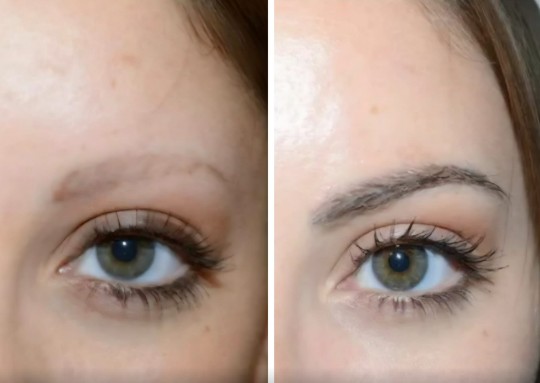
What happens immediately after treatment?
Newly placed eyebrow grafts may be surrounded by redness, tiny crusts and temporary swelling. The donor area also requires aftercare. Patients should receive instructions about cleansing, sleeping position, avoiding friction and when to resume cosmetics or face washing. Do not pick crusts, rub the brows or apply unapproved skin products simply to improve the appearance for travel. The exact day for a supervised wash or clinic review depends on the treating team’s protocol. Increasing pain, fever, spreading redness, pus or unexpected swelling should prompt medical advice. A long-hair operation is still a surgical procedure with recognised risks.
Why the initial look is not the final outcome
Keeping hair shafts long can make the postoperative brow appear fuller on the day of surgery, but this is not a preview that guarantees final growth. Some transplanted shafts may shed in the weeks that follow. New growth may become visible gradually over several months, with maturation commonly assessed toward the end of the first year or later in some cases. The pattern and timing vary by patient. Poor graft growth, asymmetry or hair that points in an unwanted direction can occur. A clinic should not promise that long-hair FUE allows patients to skip the normal biological recovery cycle.
Long-term trimming and grooming
When follicles are taken from the scalp, transplanted eyebrow hairs may retain characteristics of scalp growth and require regular trimming. The frequency depends on the individual and the length and shape the patient prefers. Some hairs can need brushing or gentle styling after complete healing, according to the clinician’s advice. This does not mean the procedure has failed; it is part of understanding the difference between scalp and eyebrow hair. Ask about ongoing maintenance before choosing surgery, especially if you want an option that requires no grooming. Microblading, makeup and other alternatives have different maintenance considerations and should also be discussed.
Scar tissue, burns and previous microblading
An eyebrow transplant may be considered when a section is missing following a stable scar, injury or previous excessive plucking. However, the recipient skin may have altered blood supply, fibrosis or pigment from cosmetic tattooing. Such conditions can affect suitability and growth, so the area needs in-person assessment. Existing microblading pigment does not necessarily disappear when new hairs are implanted. A clinician may recommend waiting or treating an underlying problem first. A long-hair or unshaven technique cannot guarantee that grafts will survive in every scar. Patients should ask how the team assesses skin condition and realistic density.
When surgery may not be appropriate
Eyebrow thinning can occur with skin disease, autoimmune conditions, hormonal disorders, active inflammation or repeated hair pulling. Surgery may be inappropriate while a medical cause is active or untreated. A clinician should consider diagnosis and stability before proposing transplantation, rather than assume every sparse brow is a cosmetic problem. Donor supply and the patient’s expectations also matter. Some people may benefit from assessment by a dermatologist or another relevant specialist before any surgical planning. Patients should be comfortable hearing that a transplant is not advisable. Declining surgery where risks outweigh benefits is an appropriate clinical decision.
Long-hair technique versus standard FUE
Standard FUE can use short donor hair shafts to make follicle removal and graft preparation more manageable. Long-hair approaches preserve more shaft length, potentially helping visible orientation but sometimes changing handling complexity or procedure duration. Whether either approach is feasible depends on the donor hair and operator’s plan. The final result is governed by graft quality, placement, biology and healing, not just the shaft length at implantation. A prospective patient should ask for a direct comparison of options, including expected benefits, limitations, donor appearance and whether additional fees apply. Not all centres offer both methods, and an advertisement cannot confirm availability for your dates.
Questions for patients travelling from the UK or Europe
If you will fly to Istanbul or another Turkish treatment city, obtain the exact address of the licensed medical facility and the medical professional responsible. Ask how many nights should be allowed for consultation, procedure and early review, and whether any complications would require longer local observation. The return flight should be planned with clinical advice. Confirm what is included in airport transfers and hotel services separately from the procedure. Check your travel documents, insurance terms and any exclusions for elective medical treatment. A convenient appointment time does not guarantee a medically appropriate return date.
How to compare written quotations
A detailed quotation should identify the proposed technique, preliminary graft range, responsible treatment venue, clinical assessment, anaesthesia, washing and routine aftercare. Ask whether a long-hair or unshaven option costs extra and whether the donor area will be partially shaved. Additional expenses may include hotel nights, companions, flights, airport transfers and any elective follow-up products. Deposit and cancellation rules should be confirmed in writing. A price that looks attractive may omit crucial parts of care, while a premium label cannot establish clinical quality. Compare the clinical team and full inclusions rather than only a package headline.
Safety questions before choosing a provider
Verify the actual healthcare provider’s authorisation, the professional credentials of the responsible doctor and who performs invasive surgical steps. A travel facilitator can arrange practical services but should not be confused with the treating medical institution. Ask for an explanation of risks such as infection, visible donor marks, poor growth, incorrect hair direction, folliculitis and asymmetry. The ISHRS encourages patients to understand the roles of practitioners during hair transplantation. Claims of guaranteed results, no scars or completely painless surgery should be treated cautiously. The clinic must provide a genuine opportunity for informed consent and discussion of alternatives.
A practical photo consultation checklist
For a preliminary enquiry, provide clear frontal photographs showing both eyebrows at rest, close-up views of gaps or scars and relevant donor hair images if requested. Use natural lighting without heavy makeup, beauty filters or permanent-brow pencil that hides the skin. Explain whether the loss began after plucking, a previous procedure, illness or injury, and whether it is still changing. Describe your desired style without expecting that an image alone can determine the exact graft count. Provide sensitive health history through an appropriate secure clinical channel. The face-to-face doctor’s assessment must confirm technique, suitability, design and total graft planning.
Frequently asked questions
Does long-hair eyebrow transplantation mean no shaving anywhere?
Not necessarily. Ask whether any donor or recipient hair is trimmed and how the technique is performed.
Does DHI guarantee the natural brow direction?
No. Professional planning and careful placement are still required.
Will the new eyebrow hairs shed?
Temporary shedding can occur despite longer hair shafts being retained during the procedure.
Do scalp-derived hairs need trimming?
Often yes, because their growth behaviour may differ from natural eyebrow hair.
Can surgery correct old microblading?
Selected cases may be considered after examination; existing pigment may remain.
Can the clinic confirm 600 grafts from photographs alone?
No. A face-to-face examination is needed to decide the appropriate number.
Request an individual eyebrow assessment
A long hair eyebrow transplant in Turkey should be considered only after a qualified doctor evaluates the cause of eyebrow loss, existing brow direction, donor hair calibre, skin condition and expectations. Ask the treating medical team to explain whether standard FUE, a long-hair method or an implanter-based approach is appropriate and exactly which areas require shaving. Before travelling, request the facility identity, written medical plan, potential risks, expected local follow-up and total costs. Micro FUE Turkey can coordinate an enquiry, subject to the actual healthcare provider’s clinical judgement. This page provides general information, not personalised medical advice; recovery and results vary.