
EYEBROW TRANSPLANT AFTER MICROBLADING: CAN YOU STILL GET ONE
Microblading once felt like the perfect answer to thin, over plucked, or uneven brows. For many people it was. But a few years on, the reality is often different. The pigment has faded to an odd grey, blue, or reddish tone. The strokes have blurred into a soft shadow. The shape no longer suits your face, and you are back to topping it up with pencil every morning. If this sounds familiar, you have probably started asking one specific question: can I still get an eyebrow transplant after microblading? The short answer is yes, in most cases. This guide explains exactly how it works, what your surgeon checks, and how to plan it properly.
WHY SO MANY MICROBLADING PATIENTS LOOK FOR A PERMANENT FIX
Microblading is a semi permanent cosmetic tattoo. Fine pigment strokes are placed into the upper layers of the skin to imitate brow hairs. It looks fresh and defined at first, but it does not last. Most results begin to fade within twelve to twenty four months and need regular top ups to stay sharp.
Over time, several frustrations tend to build up. The colour shifts as the pigment breaks down. The crisp hair like strokes spread and soften under the skin. The shape becomes dated or no longer flatters a changing face. And the ongoing cost of touch ups, year after year, starts to feel endless. Crucially, microblading never adds a single real hair. The moment you stop maintaining it, you are back where you started. This is why so many people eventually look past it toward a genuinely permanent solution that uses living hair.
CAN YOU HAVE AN EYEBROW TRANSPLANT IF YOU ALREADY HAVE MICROBLADING
In the great majority of cases, yes. Microblading pigment sits in the upper dermis. It does not normally destroy the underlying tissue or prevent a surgeon from placing grafts. An eyebrow transplant works on a completely different level, moving living hair follicles from your scalp into the brow, where they take root and grow for life.
Because the two procedures operate in different layers of the skin, having had microblading rarely rules out a transplant. What matters far more is the current condition of the skin in your brow area. Your suitability is decided by a proper assessment, not simply by whether you once had a cosmetic tattoo.
WHAT YOUR SURGEON CHECKS BEFORE TRANSPLANTING OVER MICROBLADING
A careful consultation is essential before any eyebrow transplant, and even more so when there is a history of microblading or permanent makeup. Your surgeon will look at several things.
The first is the health and texture of the skin. Microblading done once, gently, by a skilled artist usually leaves the skin in good condition. Repeated or aggressive sessions over many years can sometimes create scar tissue or fibrosis beneath the surface. Heavily scarred skin has a poorer blood supply, and good blood supply is what feeds transplanted follicles, so this can affect how well grafts survive.
The second is the amount of remaining pigment and how deep it sits. Faded, superficial pigment is rarely a problem. Older, darker, or deeply placed permanent makeup may remain faintly visible for a while after surgery, though new hair growth typically masks it.
The third is your donor area. As with any eyebrow transplant, the surgeon needs healthy single hair follicles, usually from the back or sides of the scalp, that match the fine texture of brow hair.
Only after weighing these factors can a surgeon confirm you are a good candidate and design a realistic plan. This is one reason a detailed online consultation, with clear close up photos of your brows, is so valuable before you travel.
DO YOU NEED TO REMOVE THE MICROBLADING FIRST
This is one of the most common worries, and the answer reassures most people. In the majority of cases you do not need to have the microblading removed before a transplant.
Transplanted follicles are placed between and around existing pigment, not blocked by it. The pigment itself will continue to fade naturally over the following months and years, while your new, real hairs grow in and become the dominant feature of the brow. As the hair fills in, any residual shadow of old pigment becomes far less noticeable.
Laser tattoo removal is usually unnecessary and is not always advisable close to surgery. Aggressive laser treatment can irritate or damage the very skin your surgeon needs to keep healthy for graft survival. If removal is ever recommended in a specific case, it should be planned well in advance and fully healed before any transplant. Your surgeon will advise what is right for your individual situation rather than applying a blanket rule.
HOW THE PROCEDURE WORKS
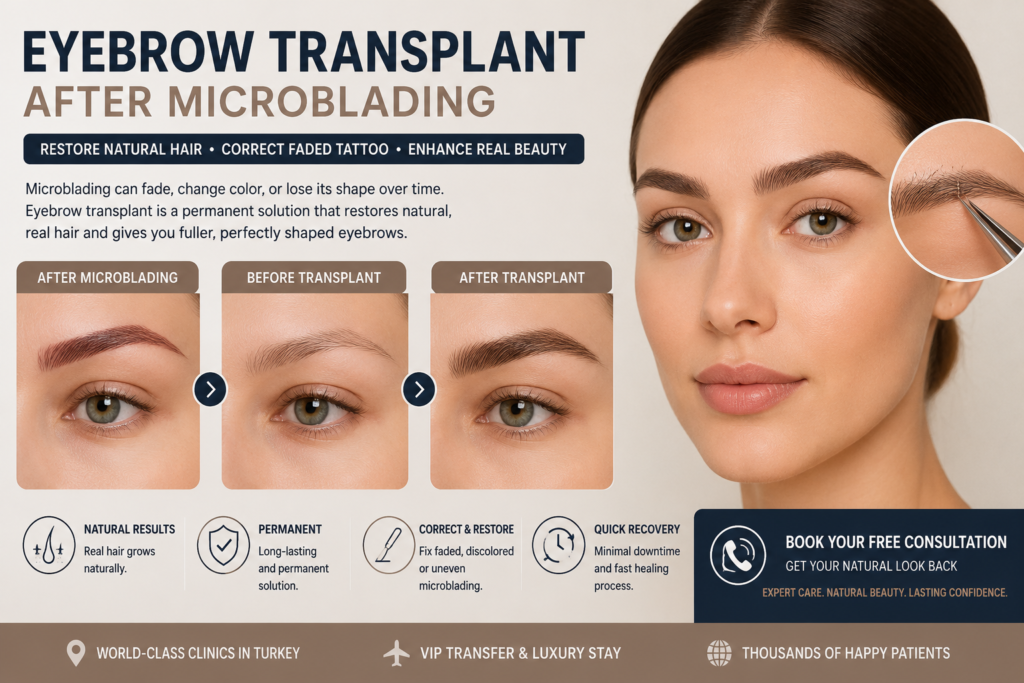
An eyebrow transplant after microblading follows the same precise process as any brow restoration. It is performed under local anaesthetic as a day procedure, so you are awake but comfortable and go back to your hotel the same day.
First, the brow is designed. Your surgeon maps the shape, arch, length, and density to suit your facial structure, often improving on the outdated shape left by old microblading. Next, fine single hair follicles are extracted individually from the donor area using a micro punch, leaving no linear scar. Finally, each follicle is implanted at a very shallow angle, typically around ten to fifteen degrees, following the natural flow of brow hair. This angle and direction are what make the result look like real, growing eyebrows rather than a flat or painted shape.
Most eyebrow transplants use between 150 and 400 grafts in total, depending on how sparse the brows are and the fullness you want. The whole procedure usually takes two to four hours.
RECOVERY AND WHAT TO EXPECT
Recovery is quick and straightforward. In the first few days, tiny crusts form around each graft and there may be mild redness or slight swelling. These settle within roughly a week, and most people return to normal social activity within a couple of days.
Between weeks two and four, the transplanted hairs shed. This shock shedding alarms first time patients, but it is completely normal. The follicle stays safely in place beneath the skin and begins to produce new hair around the third month. The brows fill in gradually, with the final, mature result visible at around six to twelve months.
Because the new hairs come from the scalp, they keep scalp growth characteristics and grow longer than typical brow hair. This simply means light trimming every couple of weeks to maintain the shape, a small trade for a permanent, natural result.
EYEBROW TRANSPLANT VERSUS MORE MICROBLADING
If your microblading has faded or shifted, you face a choice between topping it up again or moving to a transplant. The difference comes down to permanence and material.
More microblading means more pigment, more fading, and more touch ups, indefinitely, with no real hair ever added. An eyebrow transplant is a one time procedure that uses your own living follicles to rebuild the brow. The hair grows, can be shaped and styled, and does not fade to an unnatural colour because it is real hair, not ink. For anyone tired of the maintenance cycle, the transplant is the option that finally ends it.
WHY PATIENTS CHOOSE TURKEY FOR THIS PROCEDURE
Turkey has become the world’s leading destination for eyebrow restoration, and that depth of experience matters especially for patients with a microblading history. High volume specialists handle delicate brow design and pigment affected skin routinely, refining the angle and density work that makes or breaks a natural result.
Alongside that expertise, Turkish clinics offer modern facilities, transparent all inclusive packages, and prices well below those in the UK, Europe, or the United States, often with the procedure, accommodation, and transfers bundled into one clear cost. For a delicate, design led procedure like this, choosing an experienced surgeon over the cheapest option is always the wisest decision.
FREQUENTLY ASKED QUESTIONS
Will the transplant cover my old microblading The new hair grows over and between the pigment, and the microblading continues to fade naturally, so over time the real hair becomes the dominant, natural looking feature.
How long should I wait after microblading before a transplant There is no fixed rule, but it is sensible to let the skin settle after a recent session. Your surgeon will confirm timing based on the condition of your brow skin.
Is the result permanent this time Yes. Unlike microblading, transplanted follicles are living hair and grow for life, which is exactly why so many people make the switch.
Does old pigment affect how natural it looks When designed and angled correctly, the transplanted hair looks like natural brows. Any faint residual pigment generally fades and is masked by the new growth.
TAKE THE NEXT STEP
If microblading no longer gives you the brows you want, you are not stuck choosing between fading ink and a daily pencil. A permanent, natural solution is within reach, even after years of cosmetic tattooing. Share a few clear, close up photographs of your brows with a specialist team for a personalised assessment, an honest opinion on your skin and candidacy, and a treatment plan designed to give you real, lasting eyebrows.