
FUE VS DHI EYEBROW TRANSPLANT WHICH TECHNIQUE GIVES BETTER RESULTS IN 2026
If you have started researching eyebrow transplant Turkey options, you will have encountered the same crossroads as every other patient before you: should you choose FUE or DHI? Both are modern, scientifically validated methods. Both produce permanent, real hair growth. Both are performed across the leading Turkish clinics on a daily basis. But they are not the same procedure, and the technique your surgeon uses will directly affect your density, your recovery, your scarring, and the final natural appearance of your brows.
This is the comprehensive, no-shortcuts FUE vs DHI eyebrow transplant comparison that international patients have been asking for. Eyebrow Transplant Turkey breaks down exactly how each method works, where each one wins, and how to decide which technique is right for your specific case before you fly to Istanbul, Antalya, or Bodrum.
WHAT IS FUE EYEBROW TRANSPLANT
FUE stands for Follicular Unit Extraction. It is the foundational hair restoration technique that revolutionised the industry by replacing the older FUT strip method. In an FUE eyebrow transplant, individual hair follicles are harvested one by one from the donor area at the back of the scalp using a micro-punch tool, usually fitted with a sapphire blade for cleaner, more precise extraction.
After extraction, the surgeon opens microscopic channels in the eyebrow skin at carefully calculated angles, depths, and directions. The harvested follicles are then placed into these pre-opened channels using fine forceps.
FUE is the gold standard of modern hair transplantation. The Sapphire FUE variation, widely used in Turkey, offers exceptional channel precision and minimises trauma to the surrounding tissue.
WHAT IS DHI EYEBROW TRANSPLANT
DHI stands for Direct Hair Implantation. It is an evolution of FUE that eliminates the channel-opening step. Instead of pre-cutting incisions, the surgeon loads each extracted follicle directly into the hollow tip of a specialised tool called the Choi Implanter Pen, then implants the follicle into the skin in a single motion.
The Choi pen has an ultra-fine 0.6mm to 0.8mm tip and allows the surgeon to control three critical variables simultaneously: the depth of placement, the angle of implantation, and the direction of hair growth.
Because the entire procedure happens in one combined motion, the follicle spends significantly less time outside the body, which is one of the most discussed advantages of the DHI method.
THE CORE TECHNICAL DIFFERENCE
The defining difference is the channel.
FUE requires two distinct steps. First, the surgeon opens recipient channels using a sapphire or steel micro-blade. Second, the follicles are placed into those channels using forceps.
DHI combines both steps into one. The Choi pen punctures the skin and delivers the follicle in the same motion.
This is not a small difference. It changes the time the follicles spend outside the body, the precision of placement, the level of bleeding during the procedure, and the recovery experience afterward.
GRAFT SURVIVAL RATE FUE VS DHI
Graft survival is the metric that ultimately determines your final eyebrow density.
In FUE eyebrow transplant, harvested follicles wait in a preservation solution while the recipient channels are being opened. The total time outside the body is typically longer, which can affect survival rates in the hands of slower or less experienced teams. Skilled FUE surgeons using rapid, well-organised workflows can still achieve survival rates exceeding 90 percent.
In DHI eyebrow transplant, follicles are implanted within minutes of extraction. The reduced extracorporeal time generally results in slightly higher survival rates, with top Turkish clinics regularly reporting 95 percent and above.
The difference is real but smaller than commonly advertised. Surgeon skill matters more than the technique label. A world-class FUE surgeon will outperform an average DHI surgeon every time.
DENSITY ACHIEVABLE WITH EACH TECHNIQUE
Eyebrow density is one of the most important aesthetic outcomes, and the technique used directly affects how dense the result can be.
FUE allows for high density, but channel spacing must be carefully calculated to avoid damaging adjacent grafts. Pushing density too high with FUE risks compromising survival rates.
DHI generally allows for slightly higher density per square centimetre because the Choi pen places each graft with millimetric precision directly into the skin. This is particularly valuable in the eyebrow head, where natural brows are densest and where weak coverage is most visually obvious.
For patients seeking very dense, fully filled brows in a single session, DHI tends to be the preferred choice.
RECOVERY TIME COMPARISON
Recovery is where many patients notice a real practical difference.
FUE eyebrow transplant recovery typically takes 7 to 10 days for visible scabbing and redness to fully resolve. Some patients see slightly more pinpoint bleeding in the first 48 hours due to the open channels.
DHI eyebrow transplant recovery is faster, with most patients returning to social life within 3 to 5 days. Bleeding during the procedure is minimal because the Choi pen creates such a small entry point and seals it almost immediately.
For international patients flying back to the UK, USA, Australia, or Germany within a week of the procedure, DHI offers a more discreet recovery window.
SCARRING AND DONOR AREA
Both techniques are essentially scar-free in the eyebrow recipient area itself. The differences appear in the donor zone at the back of the head.
FUE leaves tiny, scattered dot-shaped micro-scars in the donor area, generally invisible unless the head is shaved to less than 2mm.
DHI uses the same FUE-style extraction at the donor zone, so the donor scarring profile is essentially identical. There is no meaningful donor scar difference between the two techniques.
Anyone telling you DHI is completely scar-free and FUE is not is either misinformed or selling. The extraction step is the same. The difference is only in how grafts are implanted.
PROCEDURE DURATION
FUE eyebrow transplant typically takes 3 to 5 hours from start to finish.
DHI eyebrow transplant generally takes longer, often 4 to 6 hours, because the Choi pen requires careful loading of each individual follicle between implantations and the team must work in a coordinated extraction-to-implantation rhythm.
Patients sometimes assume DHI is faster because it is the more modern method. The opposite is usually true. DHI is more time-intensive, which contributes to its slightly higher price point.
COST DIFFERENCE FUE VS DHI EYEBROW TRANSPLANT
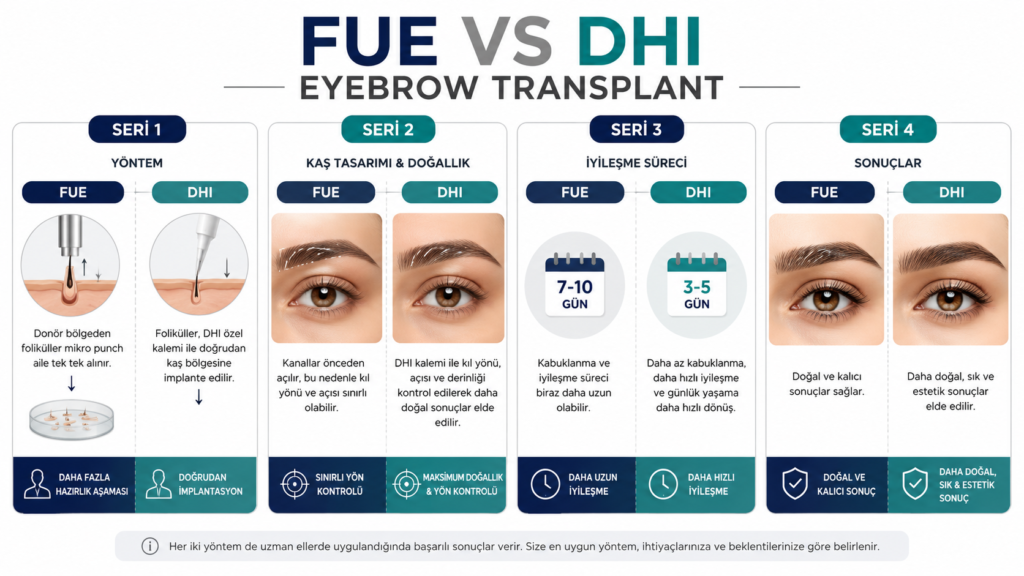
In Turkey, DHI eyebrow transplant is typically priced 10 to 25 percent higher than FUE eyebrow transplant due to the cost of single-use Choi pen tips, the longer procedure time, and the additional surgical precision required throughout the session.
That said, both techniques in Turkey remain dramatically more affordable than equivalent procedures in the UK, USA, or Australia. Eyebrow Transplant Turkey offers all-inclusive packages that bundle the surgical procedure, hotel accommodation, VIP airport transfers, translation, and post-operative aftercare, regardless of the chosen technique.
The cost difference between FUE and DHI within Turkey is small compared to the price gap between Turkey and Western clinics. Choosing the right technique matters more than choosing the cheapest one.
WHICH TECHNIQUE IS BETTER FOR YOUR SPECIFIC CASE
This is where the comparison becomes personal.
FUE eyebrow transplant is generally the better choice when:
The patient needs a very large number of grafts and procedure efficiency matters The patient has thick or fibrous skin in the eyebrow area Budget is a primary consideration The surgeon is highly experienced specifically in Sapphire FUE eyebrow work
DHI eyebrow transplant is generally the better choice when:
The patient prioritises the highest possible graft survival rate Maximum density is required in a single session Faster recovery and minimal visible signs of the procedure are critical The patient has previous eyebrow scarring or microblading damage requiring millimetric precision The clinic is using genuine, single-use Choi pen tips and trained DHI staff
For most patients with standard eyebrow restoration needs, both techniques deliver excellent natural results. The decision often comes down to surgeon recommendation, recovery preferences, and personal budget.
THE SURGEON SKILL FACTOR
This point cannot be overstated.
A talented FUE surgeon will outperform an inexperienced DHI surgeon every single time.
Eyebrow transplantation is an art as much as a science. The transplanted hair must exit the skin at the natural 10 to 15 degree angle of the brow, follow the natural fanning direction of each region, and integrate seamlessly with any remaining native hairs. No technique compensates for poor design or weak surgical judgement.
When choosing between FUE and DHI, the most important question is not which technique. It is which surgeon. Look at before and after portfolios, ask how many eyebrow procedures specifically the surgeon performs each year, and request to see results that have aged at least 12 months.
WHY TOP TURKISH CLINICS OFFER BOTH METHODS
Leading eyebrow transplant clinics in Turkey, including Eyebrow Transplant Turkey, perform both FUE and DHI procedures because each patient is different. A clinic that only offers one technique is limiting its patients, not specialising.
After your initial consultation, the medical team evaluates your skin type, hair characteristics, donor area density, desired final result, and recovery constraints to recommend the technique that delivers the best outcome for you specifically.
This individualised approach is one of the reasons international patients consistently rate Turkish eyebrow transplant clinics among the top in the world.
HOW TO DECIDE BEFORE YOU TRAVEL
Three simple steps will give you clarity.
First, send clear, well-lit photos of your current eyebrows via WhatsApp or the online consultation form on Eyebrow Transplant Turkey.
Second, ask the medical coordinator specifically which technique they recommend for your case and why. The answer should reference your skin type, your graft count requirement, and your recovery window, not generic marketing language.
Third, confirm that the surgeon performing your procedure has dedicated eyebrow restoration experience, not just general hair transplant volume. Eyebrow precision is a specialised, separate skill.
START YOUR EYEBROW TRANSPLANT JOURNEY WITH CONFIDENCE
Whether FUE or DHI is the right choice for you, the team at Eyebrow Transplant Turkey will guide you through the decision with full transparency. Patients from the United Kingdom, the United States, Australia, Germany, and across Europe and the Middle East are welcomed every week at our partner clinics in Istanbul, Antalya, Bodrum, and across the Turkish Aegean and Mediterranean coast.
Send your eyebrow photos today via WhatsApp or the online consultation form. Within hours you will receive a personalised technique recommendation, graft count estimate, all-inclusive package pricing, and available appointment dates.
Real brows. Permanent results. The right technique for your face.
Contact Eyebrow Transplant Turkey today.