
BOTCHED EYEBROW TRANSPLANT: HOW TO REPAIR, FIX AND REVISE A FAILED EYEBROW TRANSPLANT IN TURKEY
There is a specific kind of regret that only shows up in the mirror every single morning. You saved for the procedure. You trusted the clinic. You were promised natural, fuller brows — and instead you are now staring at hairs growing in the wrong direction, a “doll-hair” look that no makeup can hide, or two eyebrows that simply refuse to match. If that is where you are right now, take a breath. A failed eyebrow transplant is not the end of your face. It is a correctable surgical problem — and one that experienced reconstructive teams in Istanbul repair more often than most patients realise.
This is the guide nobody offered you the first time: what actually went wrong, what can realistically be fixed, and how a properly executed revision restores both your eyebrows and your confidence.
WHY EYEBROW TRANSPLANTS GET BOTCHED IN THE FIRST PLACE
An eyebrow transplant looks deceptively simple from the outside. It is not. Eyebrow hair grows at an aggressively flat angle — almost flush to the skin — and each follicle must be implanted following a precise directional map that changes across the head, body and tail of the brow. Get the angle wrong by even a few degrees and the result looks artificial forever.
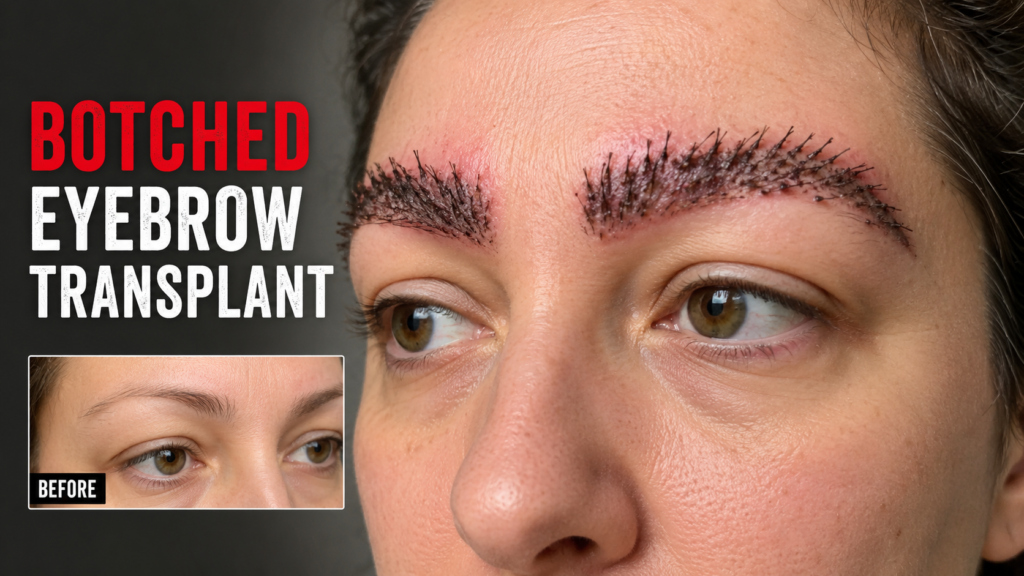
Most failed results trace back to a short list of avoidable causes:
- Inexperienced or non-specialist operators. Many budget clinics rotate eyebrow cases through technicians trained primarily on scalp hair, where angle tolerance is far more forgiving.
- Incorrect angulation and direction. The most common and most visible error — hairs that stick straight out or fan in chaotic directions instead of lying flat and sweeping naturally.
- Over-harvesting or poor graft handling. Follicles left out of solution too long, or implanted with crushing forceps, simply do not survive, leaving sparse, patchy growth.
- Wrong donor selection. Coarse, thick scalp hair placed into a delicate brow produces a heavy, wiry, unnatural texture.
- Poor design and symmetry planning. No proper facial mapping means mismatched arches, asymmetry, or a shape that fights your bone structure.
- Pure volume-driven clinics. Factories that run dozens of patients a day cannot give a brow the artistry it demands.
Understanding the cause matters, because the repair strategy depends entirely on which of these failures you are dealing with.
THE WARNING SIGNS YOUR EYEBROW TRANSPLANT HAS FAILED
Some failures are obvious within weeks; others reveal themselves only after the full 12-month maturation. You may be looking at a botched result if you recognise any of these:
- Hairs growing outward or upward instead of lying flat and directional
- A “pluggy” or doll-hair appearance — visible clumps rather than fine, blended strands
- Noticeable asymmetry between the two brows in shape, height or thickness
- Sparse or patchy density months after the shedding phase should have resolved
- An unnatural, painted-on or harsh outline
- Visible scarring at the donor area or within the brow
- Texture mismatch — hair that looks too thick, coarse or wiry for an eyebrow
Important: the first three to four months after any eyebrow transplant include a normal shedding phase, where transplanted hairs fall out before regrowing. Do not panic prematurely. A genuinely botched result is judged at the 9–12 month mark, once growth has fully matured.
CAN A BOTCHED EYEBROW TRANSPLANT ACTUALLY BE REPAIRED?
Yes — and this is the part patients are rarely told. In experienced hands, the large majority of failed eyebrow transplants can be meaningfully corrected or fully reconstructed. Revision work is more technically demanding than a first-time procedure, which is precisely why it should never be attempted by the same calibre of clinic that caused the problem.
A skilled reconstructive team can:
- Remove misdirected or pluggy grafts using fine FUE punch extraction, without scarring the brow
- Re-implant follicles at corrected angles to restore a natural flat, directional flow
- Rebalance asymmetry through precise re-mapping of arch, height and tail
- Add density into thin or patchy zones using carefully selected fine donor hair
- Refine texture and shape so the brow finally reads as your own
The goal of a revision is not just “more hair.” It is artistry correction — rebuilding the brow the way it should have been designed from the start.
HOW THE EYEBROW TRANSPLANT REVISION PROCESS WORKS
A proper correction follows a disciplined, multi-stage approach rather than a rushed re-graft.
- Detailed assessment and photographic analysis. Every existing hair’s angle, the scar map, donor reserve and skin condition are evaluated — usually possible from high-resolution photos before you ever travel.
- Custom corrective design. A bespoke brow blueprint is created around your facial proportions, golden-ratio mapping and natural expression lines.
- Selective graft removal (if required). Offending grafts are extracted individually so the canvas is clean before rebuilding.
- Precision re-implantation. Using DHI (Choi implanter) or Sapphire micro-blade FUE, follicles are placed one by one at the correct ultra-flat angle and direction.
- Healing and maturation review. Remote follow-up tracks your regrowth across the full cycle.
Depending on severity, some corrections are completed in a single session; heavily over-harvested or scarred cases occasionally require a two-stage plan.
WHY INTERNATIONAL PATIENTS CHOOSE ISTANBUL FOR CORRECTIVE EYEBROW SURGERY
Patients from London, Dublin, New York, Toronto, Sydney and across Europe increasingly fly to Istanbul specifically for revision work — not because it is cheaper, but because the concentration of high-volume specialist experience here is genuinely difficult to match elsewhere. Correction is a numbers game: the surgeons who fix the most cases are the ones who have seen the most.
Beyond expertise, the experience is built to remove every friction point for an overseas patient:
- Private clinic environment in Şişli — Istanbul’s central medical and lifestyle district, minutes from Taksim
- Door-to-door VIP airport transfers so you never navigate a foreign city stressed
- Curated partner hotels within a short transfer of the clinic
- Comfort-focused, gentle anaesthesia protocols for a calm, low-stress procedure day
- English-speaking patient coordinators managing your entire journey end to end
- A typical 3–4 day stay — short enough to feel like a discreet trip, not a medical ordeal
For a corrective patient who has already been let down once, this level of structured, white-glove care is not a luxury. It is reassurance.
WHAT DOES IT COST TO FIX A FAILED EYEBROW TRANSPLANT?
Revision pricing is genuinely case-dependent and almost always quoted only after photo assessment, because the workload varies enormously between a light density top-up and a full removal-and-rebuild.
As a realistic guide:
- Minor corrections (adding density, refining a small area) sit at the lower end — often comparable to a standard first-time eyebrow transplant in Turkey.
- Full reconstruction (graft removal plus complete re-design and re-implantation) carries a premium, reflecting the additional surgical time and skill.
Even at the higher end, corrective surgery in Istanbul typically remains dramatically below what equivalent revision work costs in the UK, Ireland, North America or Australia — where reconstructive eyebrow expertise is scarce and priced accordingly. The honest principle to hold onto: never choose your second clinic on price. Choosing cheap is what created the problem the first time.
RECOVERY AFTER AN EYEBROW TRANSPLANT REVISION
Healing after a correction closely mirrors a primary procedure, with a few nuances:
- Days 1–3: mild redness, tiny crusts around implanted follicles, minimal swelling. Most patients fly home comfortably on day 3 or 4.
- Week 1–2: crusts clear; gentle aftercare and washing routine followed exactly as instructed.
- Weeks 3–8: the expected shedding phase — transplanted hairs fall out. This is normal regeneration, not a second failure.
- Months 3–6: new growth emerges, now at the corrected angle and direction.
- Months 9–12: full, mature, natural result — the brows you should have had the first time.
Patience during the shedding phase is the single most important thing a revision patient can practise.
HOW TO MAKE SURE YOUR SECOND TRANSPLANT IS YOUR LAST
Choosing the right corrective clinic is everything. Before you book your revision:
- Confirm the team specialises in eyebrow transplantation, not only scalp hair
- Ask to see before-and-after correction cases, not just primary results
- Insist on a personalised design consultation, not a one-size template
- Verify realistic, honest expectations — a trustworthy clinic will tell you what cannot be fixed as well as what can
- Choose artistry and track record over the lowest quote, every time
A FINAL WORD — AND YOUR NEXT STEP
A botched eyebrow transplant feels permanent. It usually is not. With the right reconstructive team, the wrong angles, the gaps, the doll-hair look and the asymmetry can be re-engineered into brows that finally look — and feel — like they were always yours.
If you are living with a result you regret, the most powerful thing you can do is stop guessing and get a real assessment. Send your photos for a confidential corrective evaluation, and let a specialist tell you honestly what your repair would involve. Your second opinion could be the one that gives you your face back.
Book your confidential eyebrow transplant revision assessment today — message our Istanbul specialists on WhatsApp and send your photos for an honest, no-pressure corrective plan.
FREQUENTLY ASKED QUESTIONS
Can a botched eyebrow transplant be completely fixed? In most cases, yes. Experienced reconstructive teams can remove misdirected grafts, correct angles, rebalance symmetry and add density. The outcome depends on the original damage, donor reserve and scarring, which is why a photo assessment is essential before any promise is made.
How do I know if my eyebrow transplant failed or is just healing? True failure is judged at 9–12 months. Before that, shedding between weeks 3 and 8 is completely normal. Wrong-direction hairs, a pluggy look, persistent asymmetry or sparse density after the full year are the real warning signs.
How long should I wait before getting a revision? Most specialists recommend waiting until full maturation — around 12 months after the original procedure — so the true result is visible and the scalp and donor area have fully healed.
Will a revision leave more scarring? Modern FUE punch removal and DHI implantation are designed to minimise scarring. In skilled hands, corrective extraction is performed follicle by follicle to protect the brow and donor zone.
Is corrective eyebrow surgery more painful than the first one? No. The procedure is performed under comfort-focused local anaesthesia, and most patients describe the experience as surprisingly relaxed despite the more complex surgical work involved.
How many days do I need to stay in Turkey for a revision? Typically 3 to 4 days. The procedure itself takes a few hours, with a short follow-up before you fly home.
How much does it cost to repair a failed eyebrow transplant in Turkey? It varies by case. Minor corrections are comparable to a standard first procedure, while full reconstruction costs more — but both usually remain far below revision pricing in the UK, US, Ireland, Canada or Australia.
Can you fix hairs growing in the wrong direction? Yes. Misdirected grafts are selectively removed and follicles are re-implanted at the correct ultra-flat eyebrow angle, which is the core of natural-looking correction.
What if my original transplant was over-harvested? Heavily over-harvested or scarred cases may need a staged approach, but density and shape can usually still be meaningfully improved with careful donor management.
Why should I choose Istanbul for corrective work specifically? Istanbul has one of the highest concentrations of specialist eyebrow transplant experience in the world, combined with VIP transfers, partner hotels and full English-speaking patient support — ideal for a revision patient who needs both expertise and reassurance.
Will my repaired eyebrows look natural? That is the entire goal. A proper revision corrects angle, direction, texture and symmetry so the brows blend seamlessly with your face and read as genuinely your own.
Is the result permanent? Transplanted follicles are typically resistant to loss and generally last for life once they have matured, just like a successful primary transplant.