
EYEBROW TRANSPLANT RECOVERY: COMPLETE DAY-BY-DAY HEALING TIMELINE AND AFTERCARE GUIDE
One of the first questions every patient asks before booking an eyebrow transplant in Turkey is simple: how long until I look normal again? It is a fair question. Whether you are flying in from London, New York or Sydney, you need to know exactly what your face will look like at every stage, how long you need to stay indoors, and when you can return to work, the gym or social events. This complete recovery guide walks you through the full healing timeline, the aftercare rules that protect your grafts, and the realistic expectations that separate a successful eyebrow transplant from a disappointing one.
WHY EYEBROW TRANSPLANT RECOVERY DESERVES SPECIAL ATTENTION
Unlike scalp hair transplants where the transplanted area can be hidden under a hat or longer hair, your eyebrows are front and centre on your face. Every stage of healing is visible. The good news is that recovery is faster than most patients expect, but every day matters. The first ten days will determine whether your grafts anchor properly into their new home. Skipping aftercare steps, sleeping incorrectly, or returning to exercise too soon can compromise the survival of follicles that you have invested in. Recovery is not passive. It is the part of the procedure that you, the patient, are responsible for.
THE EYEBROW TRANSPLANT RECOVERY TIMELINE AT A GLANCE
The full eyebrow transplant healing journey unfolds across roughly twelve months, broken into clearly defined phases. Day one through day three is the immediate post-operative phase with mild redness and tiny scabs. Day four through day seven is when scabs begin to soften and detach. Week two through week three is when most patients experience temporary shedding of the transplanted hairs. From the second month through the fifth month new growth begins to emerge from the dormant follicles. Between the sixth and the ninth month density visibly improves. By the twelfth month, you are looking at your final, permanent result. Understanding this timeline removes anxiety and helps you plan your work calendar, social events and any follow-up visits.
DAYS ONE TO THREE: THE IMMEDIATE POST OPERATIVE PHASE
In the first seventy-two hours after your eyebrow transplant in Istanbul, Antalya or Bodrum, you will notice mild redness around the brow area, very small pinpoint scabs forming around each implanted graft, and possibly slight swelling that can sometimes travel down to the upper eyelids. This swelling is harmless and resolves within three to five days. Sleep on your back with your head elevated using two pillows. Avoid bending forward, lifting heavy objects or any activity that raises your blood pressure. The grafts at this stage are not yet anchored. They sit in their channels like delicate seedlings in fresh soil, and any friction can dislodge them. Most patients can fly home seventy-two hours after the procedure, although waiting four to five days is ideal where possible.
DAYS FOUR TO SEVEN: SCAB FORMATION AND EARLY HEALING
By day four the small scabs around your grafts begin to mature. This is when gentle washing becomes essential. Your medical team will provide a special saline spray and a mild post-operative shampoo. The goal during this week is to soften the scabs without rubbing or picking them. Picking scabs is the single most common reason for poor results. By the end of the seventh day, most scabs will have naturally detached. The brow area may look slightly pink underneath, but redness fades quickly. Many patients can return to office work and light social activities by day seven or eight, particularly if their job does not involve physical exertion or dusty environments.
WEEK TWO TO WEEK FOUR: THE SHEDDING PHASE
Around two to three weeks after your eyebrow transplant, something alarming happens for first-time patients: the transplanted hairs begin to fall out. Do not panic. This is called shock loss and it is a completely normal, expected part of the recovery process. The follicle itself remains safely anchored beneath the skin. Only the visible hair shaft sheds, while the follicle enters a resting phase before producing new, permanent hair. This phase is psychologically the hardest part of recovery because your eyebrows may temporarily look thinner than they did before the procedure. Trust the process. Every patient goes through this stage.
MONTHS TWO TO FIVE: THE WAITING PHASE AND EARLY REGROWTH
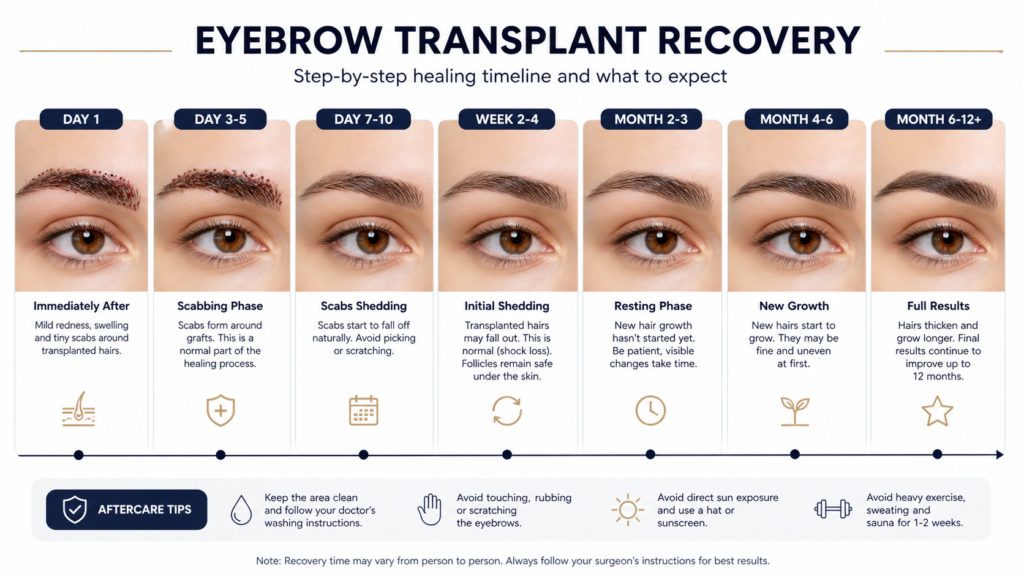
Between the second and fifth month, the dormant follicles begin to produce new hair. The first sprouts appear fine, thin and sometimes lighter in colour than your existing brows. By month four most patients see clear evidence of regrowth, although the brows still look patchy and uneven. This is normal. Hairs do not all grow at the same rate. Some follicles wake up earlier than others, creating a temporarily uneven appearance that smooths out as the slower follicles catch up. During this phase you can return to all normal activities including swimming, sauna, gym and sun exposure.
MONTHS SIX TO NINE: VISIBLE DENSITY AND SHAPING
By the sixth month, your eyebrows begin to look genuinely transformed. Density is visibly improved, the shape designed during your consultation is now clearly defined, and the transplanted hairs have thickened to match your natural brow texture. This is when most patients begin posting their results and recommending the procedure to friends and family. You will also need to start trimming your new eyebrows, because transplanted follicles come from scalp donor sites and retain their original growth rate. Light trimming every two to three weeks is part of long-term eyebrow transplant maintenance.
MONTHS NINE TO TWELVE: FINAL PERMANENT RESULTS
Between the ninth and twelfth month, the eyebrow transplant reaches its final result. Every graft has produced hair, density has stabilised, and the brows look natural, full and symmetrical. The result is permanent. The transplanted follicles, taken from the back of the scalp where hair is genetically resistant to shedding, will continue growing for the rest of your life. This is what makes eyebrow transplant a one-time, lifelong solution compared to microblading or other semi-permanent alternatives.
ESSENTIAL AFTERCARE INSTRUCTIONS FOR THE FIRST TWO WEEKS
The aftercare protocol after eyebrow transplant in Turkey is straightforward but strict. Sleep on your back with your head elevated for the first five nights. Do not touch, rub or scratch the brow area for at least ten days. Apply the prescribed saline spray every two to three hours during the first three days to keep the grafts hydrated. Wash gently from day three using only the products provided by your clinic. Avoid hot water, steam, sauna and swimming pools for at least three weeks. Avoid alcohol and smoking for the first ten days, as both compromise circulation and slow healing. Do not use any makeup, foundation, eyebrow pencil or brow gel until your medical team confirms it is safe, typically after day fifteen.
WHAT TO AVOID DURING EYEBROW TRANSPLANT RECOVERY
The list of things to avoid is short but critical. Avoid direct sun exposure on the brow area for the first month. Wear a wide-brimmed hat outdoors. Avoid intense cardio, weight lifting and contact sports for at least two weeks. Avoid sleeping face down, which can crush grafts against your pillow. Avoid scratching, picking or peeling scabs, no matter how tempting. Avoid skincare products containing acids, retinol or strong actives on or near the brow area for the first month. Avoid eyebrow tinting and tattooing for at least six months after the procedure.
WHEN CAN YOU RETURN TO WORK, SPORTS AND SOCIAL LIFE
Most patients return to office work between day five and day seven. Active lifestyles can resume gradually: light walking from day three, gym from week three, swimming from week four, sauna and steam rooms from week six. Social events such as weddings or work conferences are best planned either before your procedure or after the third month, when the shedding phase has passed and early regrowth has begun.
SIGNS OF NORMAL HEALING VERSUS WARNING SIGNS
Mild redness, small scabs, slight swelling and temporary numbness around the brows are all completely normal. What is not normal is increasing pain after day three, fever, pus or yellow discharge, spreading redness beyond the brow area, or bleeding that does not stop with gentle pressure. If any of these occur, contact your medical team immediately. Reputable clinics in Turkey provide twenty-four seven WhatsApp support and aftercare guidance for the full twelve-month recovery period, regardless of where in the world you are based.
WHY RECOVERY IN TURKEY IS COMFORTABLE FOR INTERNATIONAL PATIENTS
Turkey offers the ideal environment for the critical early days of recovery. Whether you choose Istanbul for medical excellence, Antalya for year-round warm climate, or Bodrum for premium boutique recovery, you have access to private hotels, transfer services and medical follow-ups in one organised package. The first three days are spent resting in comfort before flying home with detailed aftercare instructions in your language and ongoing remote support from your medical team.
FINAL THOUGHTS ON YOUR EYEBROW TRANSPLANT RECOVERY
Eyebrow transplant recovery is a twelve-month commitment, but the most demanding phase lasts only two weeks. Patients who follow the aftercare protocol carefully are rewarded with permanent, natural and beautifully shaped eyebrows that require no daily makeup, no microblading touch-ups and no further investment. Patience during the shedding phase, discipline during the first month, and trust in your medical team are the three ingredients that turn a good procedure into a perfect result.
Ready to plan your eyebrow transplant journey in Turkey? Contact our team today via WhatsApp at plus nine zero five five four eight nine three six four seven nine for a free consultation, personalised graft assessment and tailored recovery plan.