
HOW MANY GRAFTS DO I NEED FOR AN EYEBROW TRANSPLANT?
If you are researching eyebrow transplant Turkey and trying to understand what the procedure actually involves, one of the first questions you will ask is: how many grafts do I need? It is a fair and important question — and the honest answer is that it depends on several factors that only a qualified surgeon can fully assess. But that does not mean you should go into your consultation blind.
This guide breaks down exactly how graft numbers are calculated for eyebrow transplants, what the difference is between sparse brows and complete eyebrow loss, how density levels affect your final result, and what a realistic graft range looks like for different patient profiles. By the time you finish reading, you will have a solid understanding of what to expect before your free consultation.
WHAT IS A GRAFT IN THE CONTEXT OF EYEBROW TRANSPLANT?
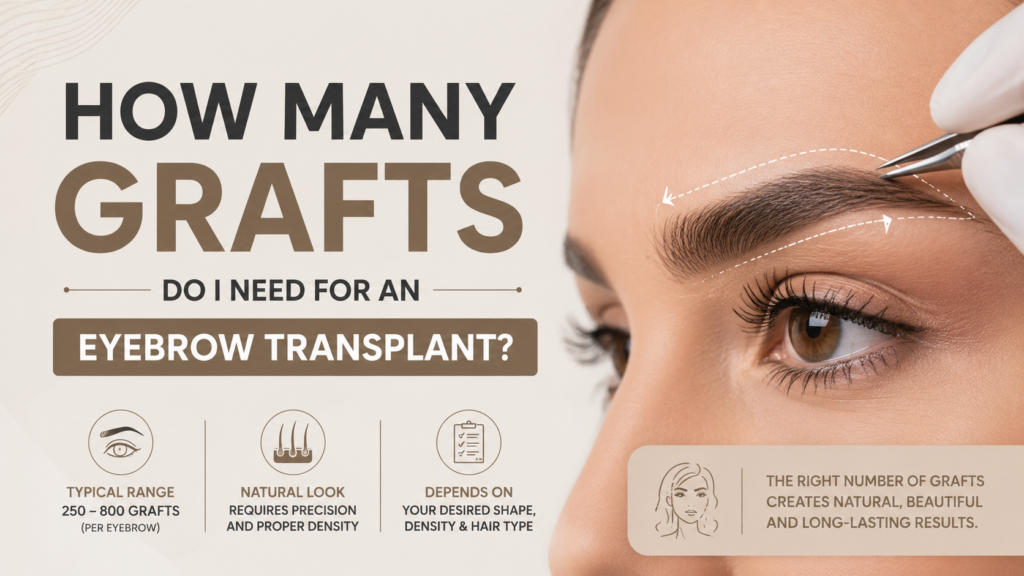
Before discussing numbers, it helps to understand what a graft actually is. A graft — also called a follicular unit — is a small bundle of one to three hair follicles extracted from the donor area, typically the back of the scalp. In hair transplant procedures for the scalp, surgeons often implant grafts containing multiple hairs per unit to maximise density quickly.
Eyebrow transplants work differently. Because natural eyebrow hairs are fine, grow at an extremely acute angle to the skin, and follow very specific directional patterns, surgeons predominantly use single-hair grafts for the eyebrow area. This gives maximum control over direction, angle, and the natural-looking result that patients want.
So when a surgeon quotes you a graft number for your eyebrow transplant Turkey procedure, they are typically referring to individual follicular units — most of which will contain a single hair — placed precisely to reconstruct or enhance your brows.
THE KEY FACTORS THAT DETERMINE YOUR GRAFT COUNT
No two patients require the same number of grafts. The number your surgeon recommends will be based on a combination of the following factors assessed during your consultation.
Your current level of eyebrow hair loss is the most significant variable. A patient with naturally sparse, thin brows who wants more density requires far fewer grafts than a patient who has experienced near-total or complete loss of eyebrow hair. These are fundamentally different procedures in terms of volume, although the technique and precision required remain equally high.
The size and shape of the eyebrow area you want to fill is the second major factor. Longer, thicker brows require more grafts to achieve uniform density than shorter or more minimal brow designs. The desired arch height, tail length, and overall width all influence the total surface area that needs to be covered.
Your desired density level also plays a significant role. Some patients want a natural, understated result that simply adds definition to existing hair. Others want a fuller, more dramatic brow that is clearly visible without any cosmetic products. Higher density means more grafts per square centimetre, which increases the total count.
Gender-specific design standards matter too. Male eyebrow transplants typically aim for a stronger, straighter, more horizontal shape with slightly higher density. Female eyebrow transplants prioritise a softer arch, a more tapered tail, and a delicate hairline at the front of the brow. These design differences affect both placement strategy and graft numbers.
Finally, your donor hair characteristics — the thickness, colour, and texture of the scalp hair being used — influence how the surgeon approaches density. Finer donor hair may require slightly more grafts to achieve the same visual density as thicker donor hair.
SPARSE EYEBROWS VS COMPLETE EYEBROW LOSS: A CRITICAL DISTINCTION
This is the most important distinction when estimating graft numbers for your eyebrow transplant Turkey procedure. Patients often group themselves into a single category when the reality is that their situation may fall anywhere along a wide spectrum.
Sparse eyebrows refer to brows that still have some existing hair but lack the density, shape, or symmetry the patient wants. This is the most common presentation and includes patients who have over-plucked for years, those with naturally light or thin brows, and patients who have experienced gradual thinning due to age or minor hormonal changes. For sparse brow patients, the transplant is about enhancement — adding grafts strategically between and around existing hairs to increase overall density and refine the shape.
Complete or near-complete eyebrow loss refers to patients who have very little or no visible brow hair remaining. This group includes patients who have experienced eyebrow loss due to alopecia areata or alopecia universalis, patients who have undergone chemotherapy, patients with thyroid disorders that have caused significant hair loss including brows, and patients with scarring from burns, accidents, or previous surgical procedures. For these patients, the transplant must create the entire eyebrow structure from scratch — both the body and the tail, the arch and the front — which requires a considerably higher number of grafts.
Understanding which category you fall into is the starting point for any honest graft estimate.
TYPICAL GRAFT RANGES: WHAT THE NUMBERS LOOK LIKE
While every case is individual, there are widely accepted ranges that give a useful starting point for patients researching eyebrow transplant Turkey options.
For patients with sparse eyebrows who want moderate enhancement, graft counts typically fall in the range of 100 to 200 grafts per eyebrow, or 200 to 400 grafts total. This applies to patients who have a reasonable base of existing brow hair and simply want more definition and density. The procedure fills in gaps, extends the tail, sharpens the arch, or adds uniformity to uneven brows.
For patients with significantly thinned or patchy eyebrows — such as those with over-plucking damage where follicles may have been permanently scarred, or patients with partial hair loss — the typical range rises to 200 to 300 grafts per eyebrow, or 400 to 600 grafts total. These patients need more comprehensive coverage but still have some existing structure to work with.
For patients with near-complete or complete eyebrow loss — including alopecia patients, chemotherapy patients, or those with significant scarring — graft counts can range from 300 to 450 grafts per eyebrow, or 600 to 900 grafts total. In some complex cases involving large scarred areas or patients wanting maximum density across both brows, the total may exceed 900 grafts.
It is important to note that these numbers refer to individual grafts, not hairs. Because many grafts used in eyebrow procedures are single-hair units, the graft count and hair count may be roughly similar — though some grafts may contain two hairs, slightly increasing the hair density relative to the graft number.
DENSITY LEVELS: WHAT DOES YOUR RESULT ACTUALLY LOOK LIKE?
Beyond the raw graft number, the concept of density — how many grafts are implanted per square centimetre of brow area — is what ultimately determines how your result looks.
A low-density result, achieved with fewer grafts spaced further apart, produces a softer, more natural look. This is often preferred by patients who want their result to appear as though their brows grew naturally and are not obviously the product of a procedure. It works well for patients who already have some base hair to blend with.
A medium-density result offers a clearly defined, filled-in brow that looks groomed and symmetrical. Most patients requesting eyebrow transplant Turkey procedures target this range because it provides visible improvement without appearing overly dramatic.
A high-density result, which requires the maximum number of grafts the brow area can safely accommodate, produces brows with strong visual impact — the kind of full, bold brow that many patients have been trying to achieve with makeup for years. This result is possible but requires an experienced surgeon to ensure grafts are placed at the correct angles and spacing to prevent unnatural clumping or directional inconsistency.
Your surgeon will discuss density expectations with you during consultation, often using design drawings or digital imaging to align your expectations with what is technically achievable given your specific anatomy and donor hair.
CAN YOU GET TOO MANY GRAFTS IN THE EYEBROW AREA?
Yes — and this is an important point that separates experienced eyebrow transplant Turkey specialists from less skilled practitioners. Over-grafting the eyebrow area is a genuine risk when surgeons prioritise volume over precision.
The eyebrow region has a limited surface area and a very specific biological environment. Unlike the scalp, the skin of the brow area is thin and has less vascular support for high-density grafting. Placing too many grafts in a single session can cause poor survival rates, as competing grafts may not receive adequate blood supply during the healing phase. It can also result in an unnatural, broom-like appearance if the angles and directions of implantation are not meticulously controlled.
Experienced surgeons will recommend a graft count that is appropriate for the area rather than simply maximising numbers. In some cases, particularly for patients wanting high density, a staged approach across two sessions may produce better long-term results than a single high-volume session.
HOW YOUR FREE CONSULTATION DETERMINES THE FINAL NUMBER
The graft numbers discussed above are reference points, not quotes. The only accurate way to determine how many grafts you personally need for your eyebrow transplant Turkey procedure is through a proper medical consultation.
Most reputable clinics — including those offering procedures across Istanbul, Antalya, Bodrum, and other Turkish cities — offer free online consultations where you submit photographs of your current brows. From these photos, the surgical team can assess your existing hair density, identify the areas of loss or thinning, evaluate your brow shape and symmetry, and provide a personalised graft estimate before you make any travel arrangements.
During this consultation you should ask specifically: how many grafts are being recommended and why, which technique — FUE or DHI — is being proposed, whether the procedure will be completed in a single session, and what density outcome is realistic given your donor hair quality.
A thorough, honest consultation at this stage is the strongest indicator of the quality of care you will receive throughout the entire process.
READY TO FIND OUT YOUR PERSONAL GRAFT COUNT?
Whether you are dealing with naturally sparse brows, the long-term effects of over-plucking, or more significant eyebrow loss from a medical condition, the first step is understanding exactly where you sit on the spectrum and how many grafts your specific case requires.
Send your brow photos through the free online consultation form or contact the team directly via WhatsApp. You will receive a personalised graft estimate, a recommended technique, and full package details — so you can make an informed decision before you book a single flight.