
Microblading vs Eyebrow Transplant Turkey: Which One Is Worth Your Money?
If you have been researching solutions for thin, sparse, or over-plucked eyebrows, you have almost certainly come across two options: microblading and eyebrow transplant. Both promise fuller, more defined brows. Both are widely available in Turkey. But they are fundamentally different procedures with completely different outcomes, costs, and long-term implications.
This guide breaks down everything you need to know before making your decision — with a specific focus on what patients travelling to Turkey for eyebrow restoration actually experience.
WHAT IS MICROBLADING?
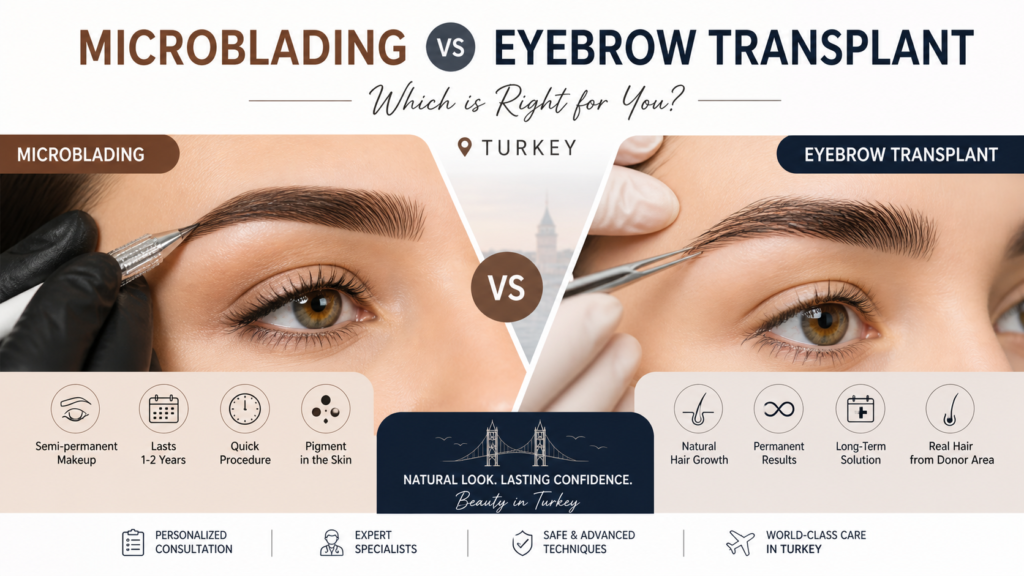
Microblading is a semi-permanent cosmetic tattooing technique. A trained technician uses a handheld tool with fine needles to deposit pigment into the upper layers of the skin, creating hair-like strokes that simulate the appearance of eyebrow hair.
The results are immediate and can look convincingly natural when done well. However, the pigment sits in the skin, not in living tissue, which means it fades over time as the skin naturally renews itself. Most patients need a touch-up session every twelve to eighteen months to maintain the look.
Microblading is not a medical procedure. It does not require a surgeon, an operating room, or anaesthesia. It is widely available at beauty salons and cosmetic studios across Turkey and internationally.
WHAT IS AN EYEBROW TRANSPLANT IN TURKEY?
An eyebrow transplant is a surgical hair restoration procedure. Individual hair follicles are extracted from a donor area on the scalp — typically the back of the head or the area behind the ears — and carefully implanted into the eyebrow region one by one.
The transplanted follicles are living tissue. Once they establish a blood supply and begin growing, they produce real hair that continues to grow permanently. The results are not pigment or ink — they are actual eyebrow hairs that can be trimmed, shaped, and groomed exactly like natural brows.
In Turkey, eyebrow transplants are performed in licensed medical clinics using either the FUE technique or the DHI method with a Choi Implanter Pen. The procedure is carried out under local anaesthesia and typically takes between three and five hours. International patients generally follow a two to three day programme that includes consultation, procedure, first wash, and departure.
THE CORE DIFFERENCE: PERMANENT VS SEMI-PERMANENT
This is the most important distinction between the two options, and it is the one that most directly affects long-term value.
Microblading is semi-permanent. The pigment fades. Sun exposure, skin type, skincare products, and the natural cell turnover cycle all accelerate that fading. Patients with oily skin often find that microblading fades significantly faster than average. Once fading begins, the colour can shift — what starts as a natural brown can gradually take on grey, reddish, or even bluish tones that require correction.
An eyebrow transplant is permanent. The follicles that survive the transplantation process and enter active growth will continue producing hair for the rest of the patient’s life. There is no fading, no colour shift, and no annual maintenance appointment. The only ongoing care required is occasional trimming, because transplanted scalp hair tends to grow at a slightly faster rate than natural eyebrow hair and may need to be kept in shape.
For patients who are tired of the maintenance cycle and want a one-time solution, this distinction alone often decides the choice.
COST COMPARISON: TURKEY MICROBLADING VS EYEBROW TRANSPLANT
Turkey is one of the most competitive markets in the world for both procedures, which is one of the reasons international patients choose it so frequently.
Microblading in Turkey typically costs between £150 and £400 per session depending on the technician’s experience and the location of the salon. Touch-up sessions are usually priced between £80 and £200. Over a ten-year period, factoring in sessions every twelve to eighteen months, the cumulative cost of maintaining microbladed eyebrows ranges from approximately £800 to £2,500 or more.
Eyebrow transplant packages in Turkey for international patients typically range from £1,200 to £2,500 in 2026. These all-inclusive packages generally cover the procedure itself, pre-operative assessments, local anaesthesia, hotel accommodation for two to three nights, airport transfers, the first professional wash, and a post-operative care kit. There are no follow-up costs, no maintenance sessions, and no repeat bookings required.
When viewed across a ten to fifteen year window, the eyebrow transplant often proves to be the more economical choice — particularly when compared to the compounding cost of microblading top-ups.
RESULTS: WHAT DOES EACH PROCEDURE ACTUALLY LOOK LIKE?
Both procedures can produce excellent aesthetic results in the right hands. But the nature of those results is very different.
Microblading results are immediate. Patients leave the session with visible, defined brows. The colour is typically slightly more intense immediately after the procedure and softens as healing progresses. When done by a skilled technician using high-quality pigments, the result can look remarkably natural. However, as fading begins, hair-stroke patterns can become less defined, and some patients find the appearance becomes patchy between touch-up appointments.
Eyebrow transplant results develop gradually. In the first two to four weeks after the procedure, the transplanted hairs typically shed — this is a normal phase called shock loss and does not mean the follicles have been lost. New growth begins to emerge between months two and four. Visible density develops between months four and eight. Full results, with complete integration of the transplanted hairs into the surrounding eyebrow area, are typically achieved between months nine and twelve.
The final result of a well-performed eyebrow transplant is real hair growing in the brow area. The hairs move naturally with facial expression, reflect light exactly as natural brows do, and require no pigment, no pencil, and no continued cosmetic intervention.
WHO IS EACH PROCEDURE RIGHT FOR?
Microblading is generally a better fit for patients who want immediate visible results, are not ready for a surgical procedure, have a temporary hair loss situation that may resolve, are working within a lower initial budget, or want to test an eyebrow shape before committing to something permanent.
An eyebrow transplant in Turkey is generally the better choice for patients who want a permanent solution with no ongoing maintenance, have chronic thinning or complete absence of eyebrow hair due to genetics, over-plucking, scarring, alopecia, or medical treatment, want results that look and feel completely natural rather than cosmetically applied, are considering travelling to Turkey for medical treatment and want to make the most of that trip, or have previously had microblading and are unhappy with the long-term appearance.
It is worth noting that the two procedures are not mutually exclusive. Some patients use microblading as a bridge during the twelve-month waiting period for their eyebrow transplant results to fully develop. This approach gives them defined brows immediately while the transplanted follicles establish and grow.
THE TURKEY ADVANTAGE FOR EYEBROW TRANSPLANTS
Turkey has become the leading destination globally for eyebrow transplant procedures for several reasons that go beyond price.
Turkish clinics that specialise in eyebrow restoration perform very high volumes of brow procedures annually. This level of experience translates directly into refined technique — particularly the precision required to implant grafts at the correct angle and direction to match natural eyebrow growth. Eyebrow hair grows at a much shallower angle than scalp hair, typically between ten and fifteen degrees, and achieving this naturally requires a level of procedural familiarity that only comes with extensive case numbers.
The donor site selection practised by experienced Turkish clinics also matters. Rather than taking all grafts from the back of the scalp, skilled surgeons may source grafts from behind the ears, where the hair is naturally finer and softer — a much closer match to the texture of natural eyebrow hair. This detail significantly affects how natural the final result looks and how well it integrates with any remaining natural brow hairs.
All-inclusive packages for international patients are another practical advantage. A single booking covers medical consultations, the procedure, accommodation, transfers, and aftercare — removing the logistical complexity that might otherwise make planning a medical trip abroad feel overwhelming.
RECOVERY: WHAT TO EXPECT AFTER EACH PROCEDURE
Microblading recovery is mild. The brow area may feel tender and appear slightly swollen or red immediately after the session. A fine scabbing layer typically forms over the strokes within the first few days. Patients are advised not to pick at the scabs and to keep the area dry. Full healing takes approximately four weeks, at which point the final colour result becomes visible.
Eyebrow transplant recovery requires slightly more care in the first ten days. The brow area and the small donor site at the back of the scalp need to be protected from friction, water pressure, and direct sunlight. Sleeping in an elevated position for the first few nights helps minimise swelling. Most patients find that visible redness and scabbing in the brow area clear within ten to fourteen days, at which point they are comfortable returning to work and social activities.
The shedding phase between weeks two and four can be the most psychologically testing part of the process for patients who were not fully prepared for it. Understanding that this is a normal and expected phase of the healing process — and that it does not affect the final outcome — makes this period significantly easier to navigate.
MICROBLADING RISKS VS EYEBROW TRANSPLANT RISKS
Every cosmetic procedure carries some risk, and it is important to understand what those risks look like for each option.
With microblading, the primary risks are pigment colour shift over time, uneven fading that creates a patchy appearance, allergic reaction to pigments in patients with sensitive skin, infection if aftercare is not followed correctly, and difficulty correcting a shape that was designed incorrectly. Laser removal of unwanted microblading is possible but expensive and requires multiple sessions.
With eyebrow transplant, the primary risks are lower-than-expected graft survival if the procedure is not performed under optimal conditions, hairs growing at an incorrect angle if the implantation technique is insufficiently precise, temporary shock loss of surrounding natural eyebrow hairs, and asymmetry if the design stage was not given sufficient attention. These risks are significantly reduced when the procedure is performed by an experienced surgeon at a licensed clinic.
The critical difference in risk profile is that microblading complications — particularly pigment issues and shape problems — can be very difficult and expensive to reverse. Eyebrow transplant results, if suboptimal, can often be refined or supplemented with an additional session.
FREQUENTLY ASKED QUESTIONS
Can I have an eyebrow transplant if I have previously had microblading?
Yes, in most cases. Surgeons will assess whether any scarring from previous microblading sessions affects the skin’s ability to support transplanted follicles. In the majority of patients, previous microblading does not prevent an eyebrow transplant from being performed successfully.
How many grafts are needed for an eyebrow transplant?
Most patients require between 150 and 400 grafts per eyebrow, depending on the degree of thinning and the desired final shape and density. This is significantly fewer grafts than a scalp hair transplant, which means the procedure is faster and the donor area impact is minimal.
Is an eyebrow transplant painful?
The procedure is performed under local anaesthesia. Patients typically describe the anaesthetic injections as the most uncomfortable moment. Once the anaesthesia takes full effect, the procedure itself is not painful. Most patients read, listen to music, or watch content during the session.
How long does an eyebrow transplant in Turkey take?
The procedure itself typically takes three to five hours. The full visit for international patients is usually structured across two to three days, including arrival and consultation on day one, the procedure on day two, and the first professional wash and departure briefing on day three.
Will the transplanted eyebrow hairs need to be trimmed?
Yes. Because the grafts are taken from scalp hair, which grows at a faster rate than natural eyebrow hair, the transplanted hairs will need occasional trimming to keep them at the appropriate length. Most patients incorporate this into their regular grooming routine without finding it particularly demanding.
How do I book an eyebrow transplant consultation in Turkey?
The most direct route is to submit photographs of your current eyebrow area via the online consultation form or WhatsApp contact. A specialist will review your photos, assess your suitability for the procedure, and provide a personalised recommendation along with package details and available appointment dates.